From Studio to Stage — The Orchid Painting, Part 2
The journey from a finished painting to an exhibition wall in Dresden.
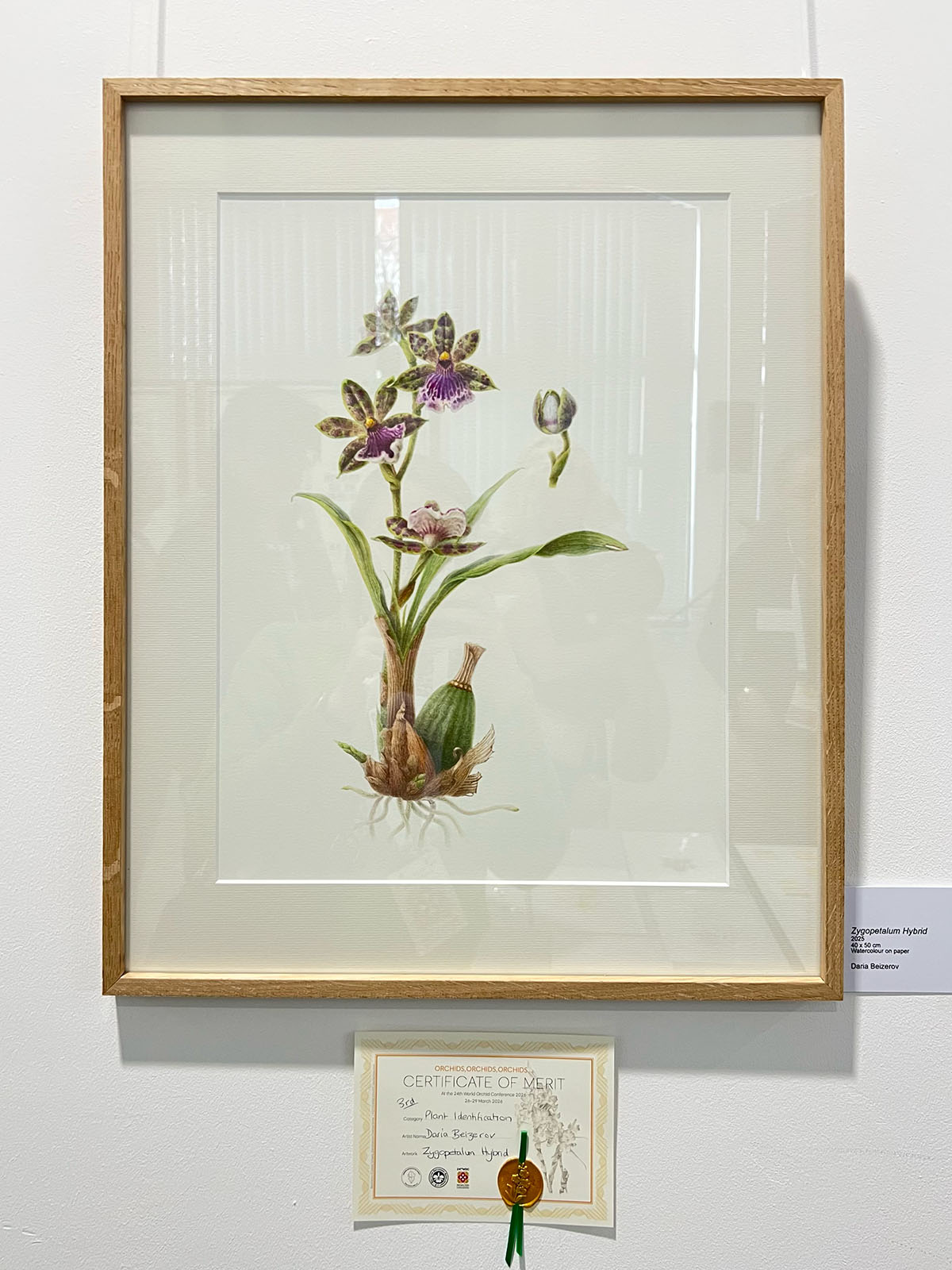
Picking up from Part 1, where the right orchid had finally been chosen and the first layers were going down on paper — the painting was finished. But a botanical watercolour is not just a painting. It is an object that must be photographed, assessed, framed, transported, and finally, seen. This is that part of the story.
Digitising the Work
I don’t yet have a reliable scanning service for large-format watercolours, so my husband and I photographed the painting ourselves — carefully lit, square to the surface, at the highest resolution we could manage. The digital file was what the jury would see first. The painting itself would come later.
The Wait
I had given everything I could to make this plant botanically precise. I wanted the painting to be more than a painted photograph — I wanted it to tell the story of a life. The life of the blooms, in particular: from tight, upright buds to fully open flowers to the slow, quiet collapse of wilting.
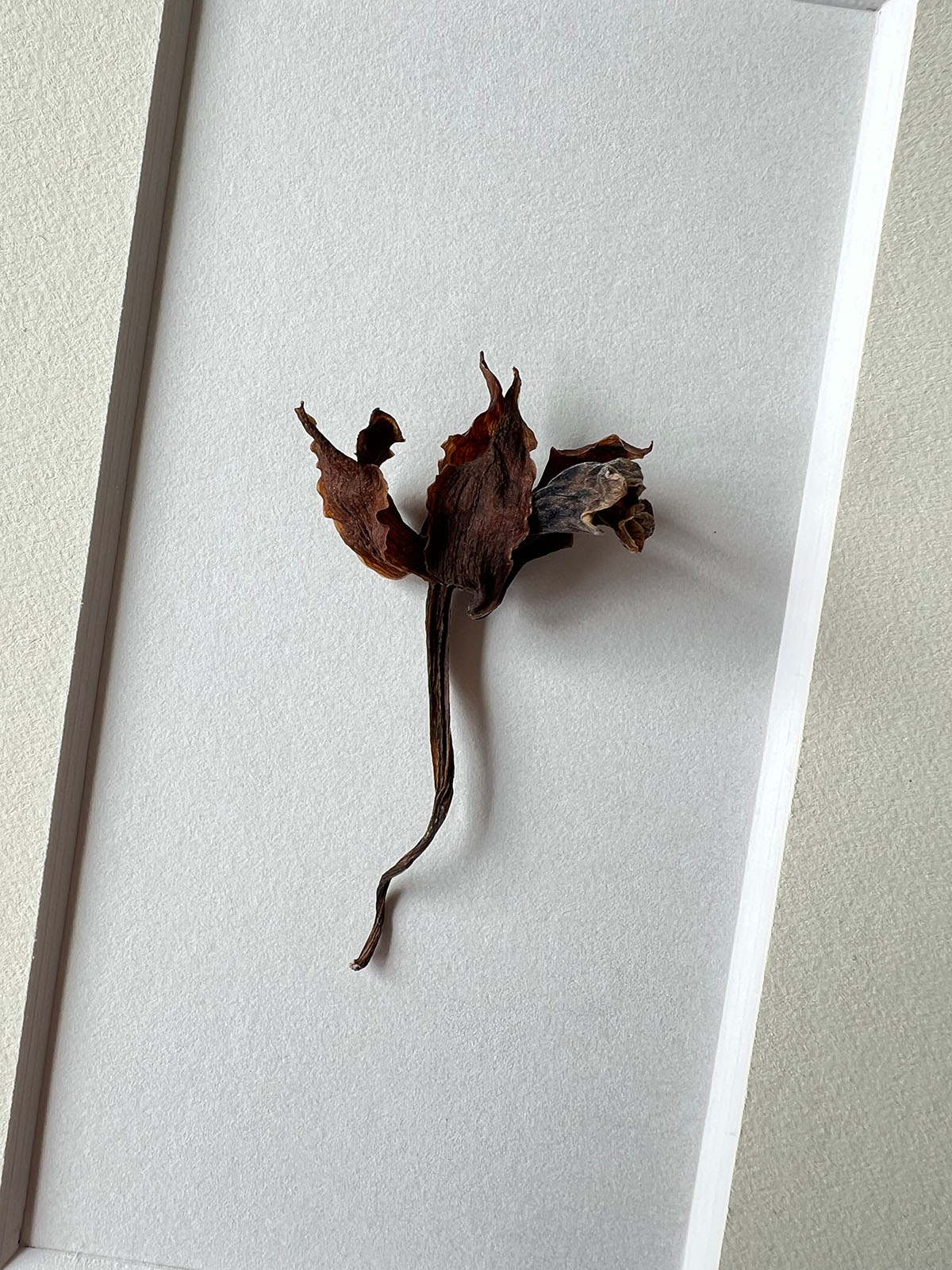
Somewhere in a small box on my shelf, the last dried flower this plant ever produced still rests — a reminder of what I was trying to hold onto.
And yet, without a scientific degree in botany, I couldn’t be certain. Had I overlooked something an orchid specialist would spot immediately? Had I found the balance between the artistic and the scientific — a colour world that felt rich but not too vivid for a real plant?
I hadn’t wanted to beautify. Where a leaf had split near the tip, I painted the split. The dried sheaths at the base are brittle, aged, translucent — and that is exactly how I rendered them.
Nothing repaired. Nothing idealised.
The confirmation came in January. I was overjoyed — but it also meant my work would hang alongside nearly fifty other paintings, judged not only by two independent juries but by every visitor who walked through the exhibition.
Framing
There wasn’t much room for personal expression in the framing — all works in the exhibition had to follow the same guidelines: light or white wood, light or white mount. Within those constraints, every detail mattered.
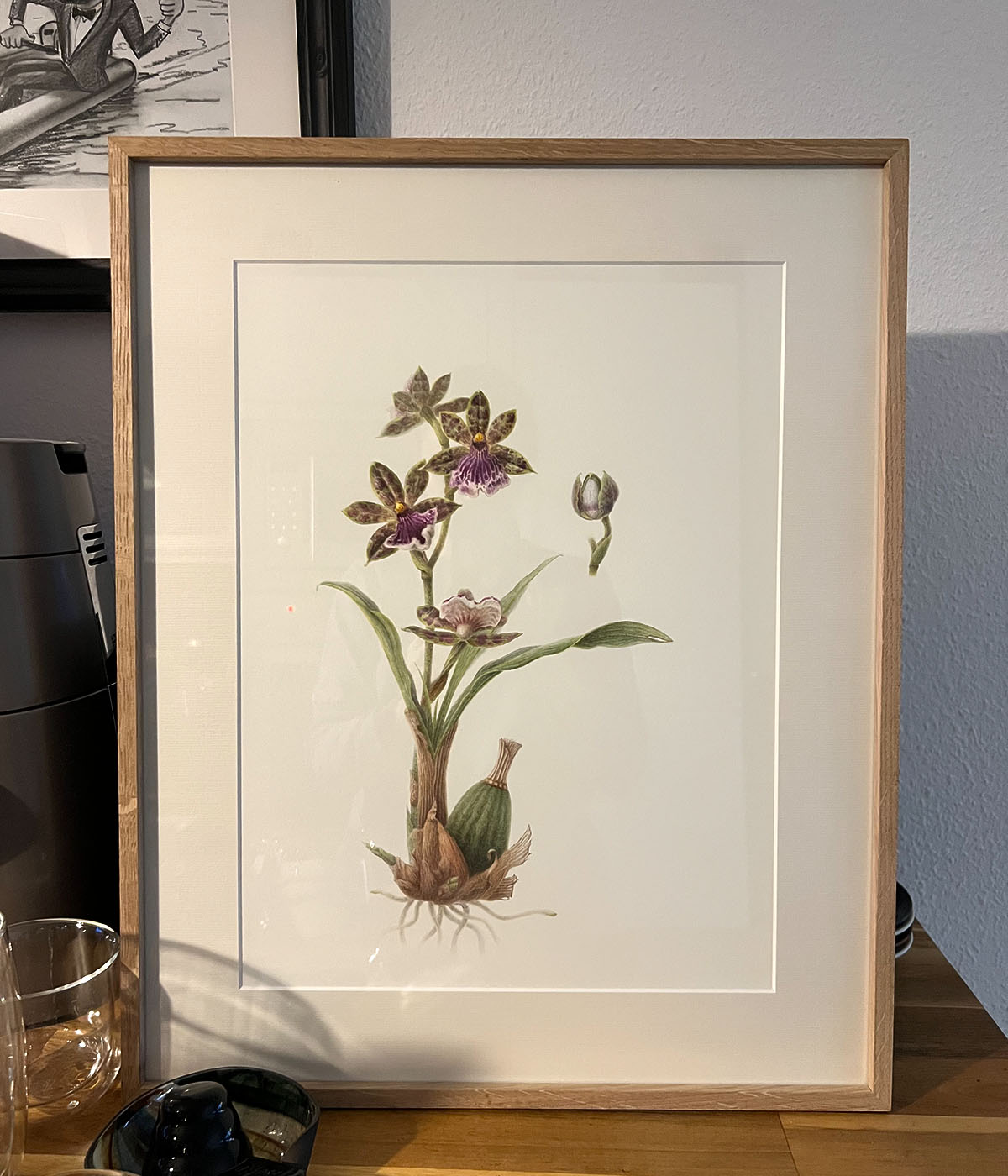
I drove to the framing service with the painting in hand. They had at least twenty shades of white mount board on offer. I needed to see each one against my paper — not on a screen, not from memory, but right there, side by side. I chose a warm ivory: neutral, slightly darker in tone than pure white. My goal was harmony so complete that the mount would become invisible — something you wouldn’t remember afterward. The warm neutral also does something quiet for the violet tones in the painting, supporting them without competing.
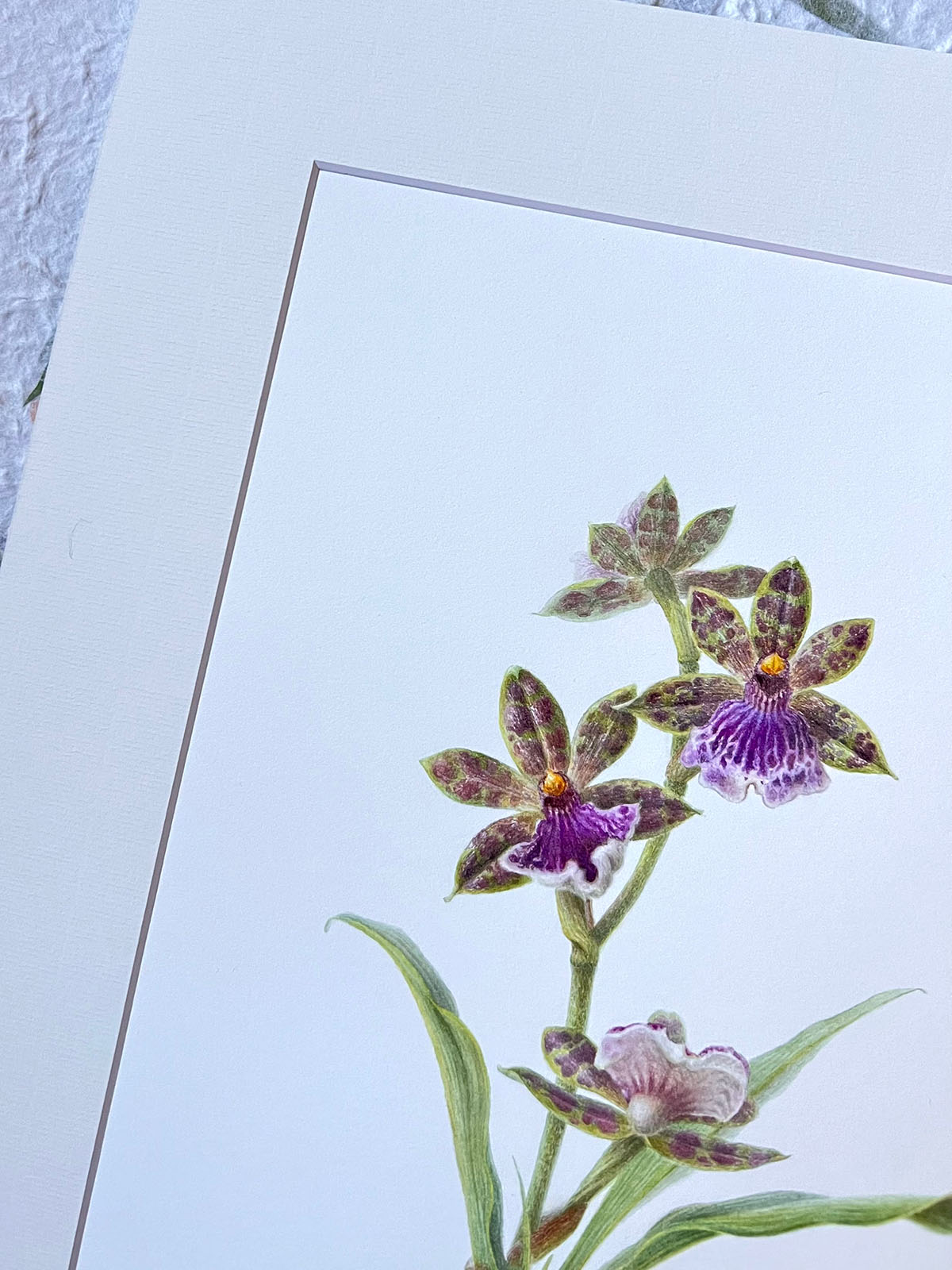
I paid attention to the surface texture, too. I didn’t want the mount to be too smooth — if it were, the subtle grain of my hot-pressed paper would appear rougher by contrast. Too bright, too smooth, too present — any of those, and the mount would distract rather than hold.
In the end, I was genuinely pleased with the result.
Dresden
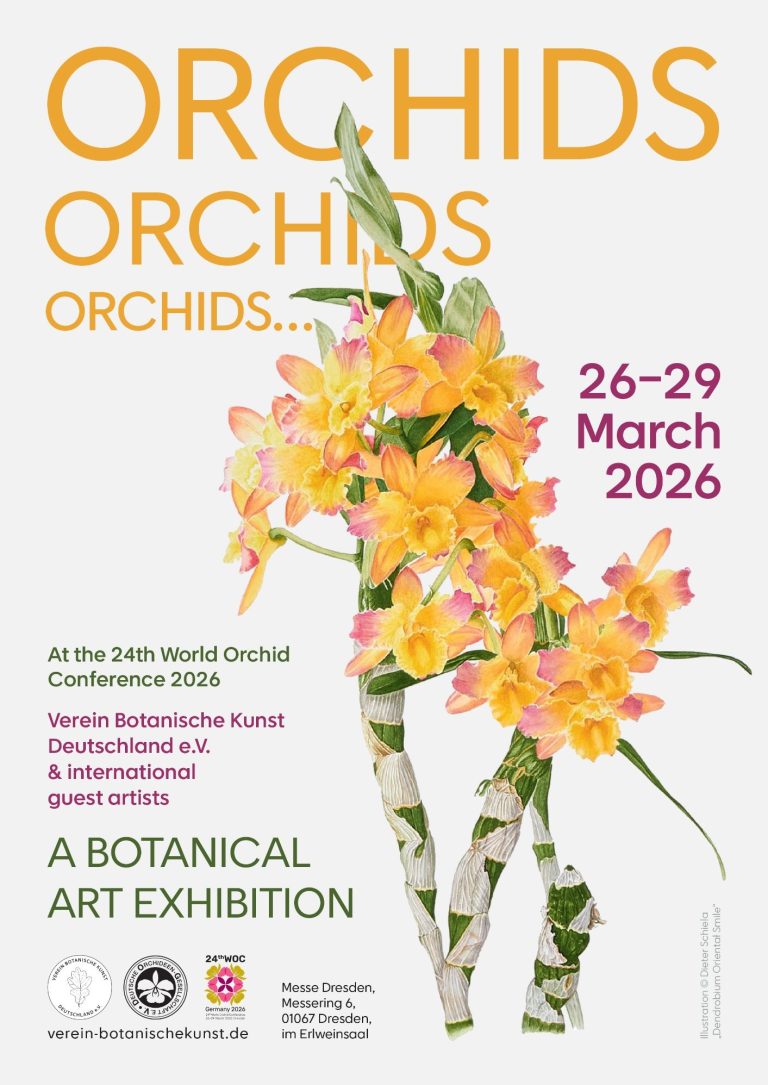
After an eight-hour drive, we arrived at the Messe Dresden for the vernissage of the 24th World Orchid Conference. I hadn’t seen my painting in roughly six weeks — it had been packed and shipped ahead of me, hung with care by the team at the Society of Botanical Art Germany (VBKD), who organised the entire exhibition.
And then, there it was. On the wall. Among nearly fifty works, including paintings by artists I have admired for years — artists whose exhibitions I once thought I could never be part of.
In that moment I knew: the months of searching for the right orchid, the botanical journal, the pigment tests, the drives across town, the tracing paper, the countless brush-kilometres — all of it had led here. And it was worth every hour.
The Certificate
The day before the award ceremony, we were all gathered for a brilliant painting demonstration by Deborah Lambkin. I was standing with my back to my painting. At some point I shifted to find a different seat — and caught something in the corner of my eye. A small card had appeared beneath my work.
A Certificate of Merit, 3rd Place for Plant Identification.
It had arrived as quietly as the painting itself.
For a moment, I didn’t believe what I was reading.
It is, for me, a confirmation: that if you look closely enough, if you learn your materials, if you teach yourself to truly see and to describe what you see in colour and tone — and if you are perhaps a little bit of a nerd about it — you can achieve something that matters.
I am deeply grateful to the VBKD for the organisation of the exhibition, to the German Orchid Society for hosting the 24th World Orchid Conference in Dresden, and to the WOC itself — for creating a stage where botanical science and art meet as equals.
Studio Letter
My Signature Palette


